
Why Irish storms snap shallow fences, and how to stop it
Shallow 300 mm timber post holes fail in Irish winter gales. Contractors set 2.4 m concrete H-posts at least 600 mm deep in concrete (750 mm on exposed western or coastal ridges) with a 300 mm concrete gravel board keeping timber completely clear of damp grass.
Concrete footing depths, H-post reinforcement, gravel boards and wind-bleed boards engineered for Atlantic gusts.
Free, no obligation. One local contractor prices it, not five.
- 600 mmminimum standard post footing
- 750 mmexposed Atlantic or 2.0 m footing
- 300 mmconcrete gravel board clearance
- 20%–30%gust relief on hit-and-miss
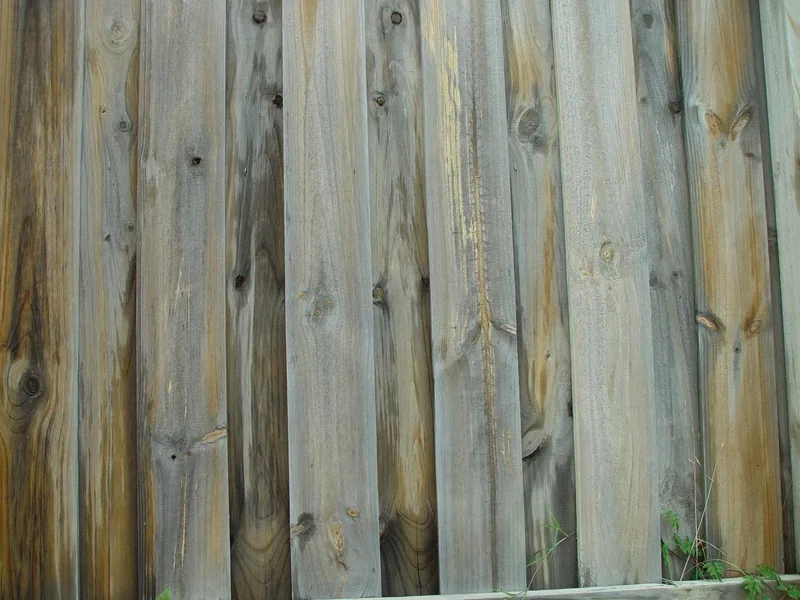
Three failure points behind almost every blown-down garden fence
When an Atlantic storm crosses Ireland, most residential fences do not fail in the middle of the panel. They snap right at soil level or pivot sideways out of wet clay. Three shortcuts cause almost all storm failures:
- Shallow 300 mm to 400 mm post holes. A solid 1.8 m × 1.83 m panel presents over 3.2 square metres of wind sail per bay. In saturated winter soil, a shallow concrete collar rocks back and forth until the entire post leans or lifts out.
- Ground-line collar rot on timber posts. Soil moisture, lawn clippings and oxygen meet in the top 50 mm of earth. Untreated or lightly treated UC3 wooden posts rot quietly at ground level until one gust shears every post in a neat row.
- Zero air bleed on exposed boundaries. Solid overlapping lap panels on open coastal ridges or hilltop gardens absorb the full gust peak instead of letting air bleed through staggered gaps.
Price my fence
Four taps show your fitted price guide before we ask for a phone number. One local fencing contractor rings you, not five.
Concrete H-posts and timber panels, 15 m to 30 m, with old fence removal (€95 to €163/m): €1,700 to €4,550, supplied and fitted.
How the price is worked out
The range multiplies current Irish supply-and-fit rates per linear metre by the chosen run length, adding a per-metre allowance if an old fence has to be stripped and disposed of or if bays must be stepped along sloping, stony or root-bound ground. Standard residential prices assume 1.8 m height with concrete footings at least 600 mm deep. Matching pedestrian gates, tree-stump removal, rock breakers and narrow through-house carries are confirmed on a site look. Ask whether VAT is charged at 13.5% or 23%. Only a contractor who inspects the boundary line gives a firm written quote.
Footing depths and post lengths by site exposure
Sheltered suburban semi-D garden
- Post length & depth
- 2.4 m post set 600 mm deep
- Recommended bay spec
- Concrete H-post + 300 mm concrete gravel board + heavy vertical timber or lap panel.
Open rural garden or estate edge
- Post length & depth
- 2.4 m to 2.7 m post set 650–750 mm deep
- Recommended bay spec
- Concrete H-post + concrete gravel board + vertical or horizontal hit-and-miss panel.
Exposed Atlantic coast or ridge
- Post length & depth
- 2.7 m reinforced post set 750 mm deep
- Recommended bay spec
- Hit-and-miss wind-bleed timber boards, 200 mm concrete pocket width, stainless clips.
2.0 m tall privacy boundary
- Post length & depth
- 2.7 m post set 700–750 mm deep
- Recommended bay spec
- Extra 300 mm concrete embedment offsets the extra 200 mm of top sail leverage.
Allow roughly 1.5 to 2 bags of dry-packed postcrete or 50 kg of well-compacted semi-dry gravel-and-cement mix per residential post hole, crowned slightly above soil level so rainwater sheds away from the post collar.
Related fencing guides
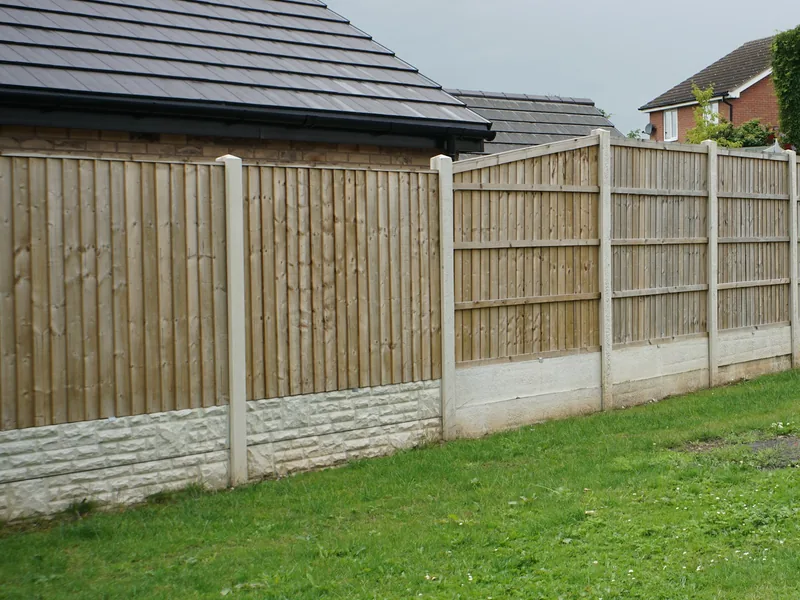 Concrete H-posts & timber panelsConcrete posts, 300 mm gravel boards and slotted timber panels built for damp Irish gardens.
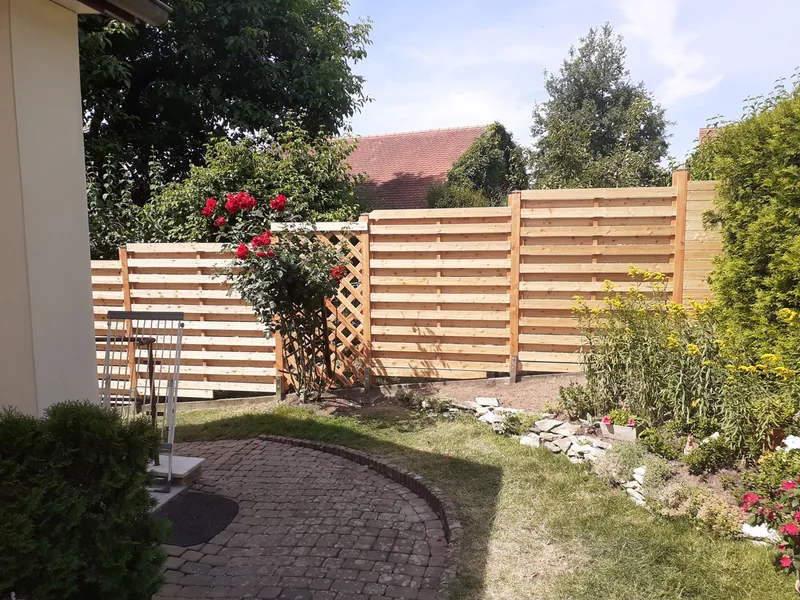 Hit-and-miss & slatted timberAlternating wind-bleed boards that stay standing in Atlantic and coastal winter gales.
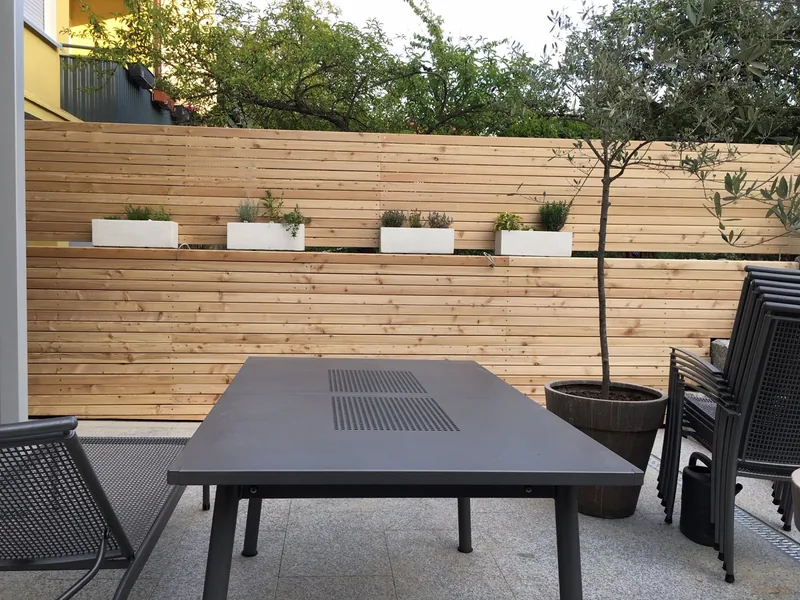 Old fence removal & sloping gardensBreaking out old concrete footings, working past tree roots and stepping panels on falls.
 UC4 timber vs composite vs concreteGround-contact Use Class 4 treatment, maintenance intervals and 20-year boundary costs.
 Galway fencing contractorsAtlantic gale wind-bleed panels, shallow limestone digging and stone-wall boundary joins.
 Fencing prices per metreSupply-and-fit Irish metre rates across all six fence systems, strip-out and slope extras.
Fencing questions answered plainly
How deep should concrete fence posts be buried in Ireland?
At least 600 mm (one third of finished fence height) in sheltered gardens, and 750 mm using 2.7 m posts on exposed coastal or 2.0 m boundaries.
Can I repair one snapped wooden post without replacing the whole fence?
Yes. A single snapped post repair using a concreted repair spur or new concrete H-post typically runs €140 to €240. If three or more timber posts have rotted at ground level, replacing the run with concrete H-posts avoids repeat storm callouts.
Why do concrete gravel boards extend panel life so much?
They lift timber 150 mm to 300 mm above wet grass, mud splash and garden strimmers, doubling the working life of wooden fence panels.
Does postcrete hold as well as mixed ballast and cement?
Rapid-set postcrete works cleanly on firm clay when thoroughly wetted and tamped. On loose made ground, heavy coastal slopes or 2.0 m fences, stiff traditional ballast-and-cement concrete gives denser mass around the base.
Every Irish fencing guide on this site
Fence styles
Specs, costs & law
Check your boundary cost before booking a visit
Pick the fence style, rough metre run and whether an old boundary has to come out. One written quote comes back from a single fencing contractor in your county.