
Planning permission for fences in Ireland
Under Class 5 of the Planning and Development Regulations 2001 (S.I. No. 600 of 2001), residential garden fences are normally exempt up to 2 m high along side and rear boundaries and up to 1.2 m forward of the front house wall. Metal palisade, sheet metal and barbed-wire front boundaries are excluded from Class 5 exemptions, and Article 9 rules out anything that blocks road sightlines. A Section 5 declaration gives the council's written confirmation on whether your boundary fence is exempt. The statutory fee is €80 and the council answers within 4 weeks.
Class 5 height limits under S.I. No. 600 of 2001, front-garden bans on wire or sheet metal, estate covenants and Section 5 checks.
Free, no obligation. One local contractor prices it, not five.
- 2 mClass 5 side and rear height cap
- 1.2 mClass 5 front garden height cap
- €80Section 5 council declaration fee
- 4 weeksstatutory Section 5 answer time
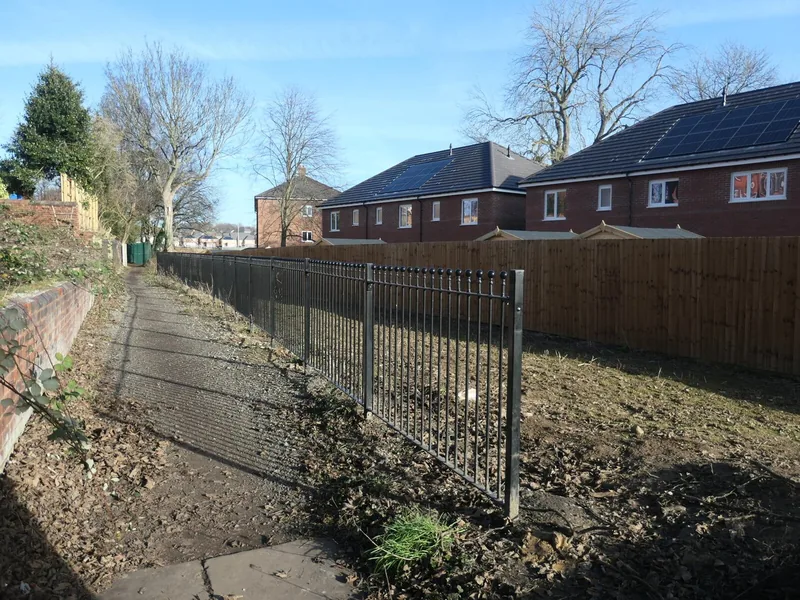
What Class 5 of S.I. No. 600 of 2001 allows
Domestic garden fences, walls and railings in Ireland are governed by Class 5 of Schedule 2, Part 1 of the Planning and Development Regulations 2001 (S.I. No. 600 of 2001), subject to Article 9 traffic-safety and heritage restrictions.
- 2 m ceiling behind the front building line. Wooden, composite and concrete-post garden fences along side passages and rear boundaries are normally exempt up to 2 m above ground level. Standard 1.8 m (6 ft) garden fencing sits safely inside the limit.
- 1.2 m ceiling in front of the house. Any wall, railing or wooden fence forward of the front wall of the house drops to a strict 1.2 m maximum height.
- No security palisade or sheet-metal domestic fences. Class 5 specifically excludes metal palisade and security fencing, and domestic front boundaries cannot use corrugated metal sheets or barbed wire.
- Road sightlines override height exemptions. Under Article 9, even a 1.2 m solid fence loses its exemption if it blocks driver visibility pulling out of a driveway or approaching a junction.
- Estate open-plan conditions stay binding. Many Irish estates granted permission since the 1990s carry a planning condition prohibiting front walls or fences altogether. Check your house deeds or planning file before fencing a front lawn.
Price my fence
Four taps show your fitted price guide before we ask for a phone number. One local fencing contractor rings you, not five.
Concrete H-posts and timber panels, 15 m to 30 m, on clear level ground (€85 to €145/m): €1,550 to €4,050, supplied and fitted.
How the price is worked out
The range multiplies current Irish supply-and-fit rates per linear metre by the chosen run length, adding a per-metre allowance if an old fence has to be stripped and disposed of or if bays must be stepped along sloping, stony or root-bound ground. Standard residential prices assume 1.8 m height with concrete footings at least 600 mm deep. Matching pedestrian gates, tree-stump removal, rock breakers and narrow through-house carries are confirmed on a site look. Ask whether VAT is charged at 13.5% or 23%. Only a contractor who inspects the boundary line gives a firm written quote.
Six Irish boundary scenarios compared
Rear or side garden timber, concrete or composite fence
- Normal Irish planning rule
- Exempt up to 2 m high
- Key check before work
- Measured from ground level on each bay; never encroach onto a public footpath.
Front garden fence forward of the front house wall
- Normal Irish planning rule
- Exempt up to 1.2 m high
- Key check before work
- Check original estate planning conditions for open-plan front garden restrictions.
Front boundary in barbed wire, chain-link or sheet metal
- Normal Irish planning rule
- Not exempt under Class 5
- Key check before work
- Class 5 prohibits security palisade, sheet metal and wire front enclosures.
Concrete block wall visible from road or public path
- Normal Irish planning rule
- Exempt within height caps only if finished
- Key check before work
- Class 5 requires concrete block walls seen from public areas to be capped and rendered.
Corner house boundary facing a side estate road
- Normal Irish planning rule
- Treated carefully under Article 9
- Key check before work
- Tall solid panels beside a junction or driveway exit can lose exemption on sightlines.
Protected Structure or Architectural Conservation Area
- Normal Irish planning rule
- Class 5 exemption disapplied
- Key check before work
- Check with the county or city council planning office before removing old ironwork or stone.
Sloping gardens, raised beds and Section 5 confirmation
Measuring height on a slope
Where gardens step downhill, Class 5 height is measured from natural ground level directly beneath each bay, not from the highest point at the top of the garden. If your lawn sits higher than your neighbour's garden on a retaining wall, council planners look at total combined visual height on the lower side too.
Adding trellis toppers
A 300 mm trellis panel added on top of a 1.8 m fence brings the total structure to 2.1 m, crossing the 2.0 m Class 5 cap. Keep panel plus gravel board plus any top trellis at or below 2.0 m if you want to stay exempt.
Getting council certainty under Section 5
A Section 5 declaration gives the council's written confirmation on whether your boundary fence is exempt. The statutory fee is €80 and the council answers within 4 weeks. Submit a site map, a sketch showing exact ground-to-top heights and materials, and the €80 fee to your county or city council. For neighbour notice rules on shared lines, read shared boundaries and the 2009 Land Act.
Fencing questions answered plainly
Can I put up a 6 ft (1.8 m) fence between back gardens in Ireland?
Yes. A 1.8 m timber, concrete-post or composite boundary fence behind the front building line sits inside the 2 m Class 5 exemption.
Can I add a trellis on top of a 2 m rear fence without permission?
No. Trellis counts towards overall fence height. Exceeding 2.0 m requires planning permission from your local authority.
How high can a front garden fence be in Ireland?
Up to 1.2 m forward of the front wall of the house under Class 5, provided it does not breach an estate open-plan condition or obstruct road sightlines.
Are concrete posts and concrete gravel boards exempt under Class 5?
Yes, within the 2 m rear and 1.2 m front caps. Bare concrete block walls visible from a public road must be capped and rendered.
What is a Section 5 declaration?
A Section 5 declaration gives the council's written confirmation on whether your boundary fence is exempt. The statutory fee is €80 and the council answers within 4 weeks.
Every Irish fencing guide on this site
Fence styles
Specs, costs & law
Check your boundary cost before booking a visit
Pick the fence style, rough metre run and whether an old boundary has to come out. One written quote comes back from a single fencing contractor in your county.