
Shared boundaries and the 2009 Land Act in Ireland
Shared garden fences and boundary walls in Ireland fall under Part 8, Chapter 3 (Sections 43 to 47) of the Land and Conveyancing Law Reform Act 2009, not the UK Party Wall Act. Talk to your neighbour before removing a boundary line, keep a dated photo record of both sides, and agree shared costs in writing.
Checking boundary ownership, giving neighbour notice under Sections 43 to 47 of the 2009 Act and agreeing shared replacement costs cleanly.
Free, no obligation. One local contractor prices it, not five.
- 2009 ActPart 8, Chapter 3 (Secs 43–47)
- No L/R rulecheck Land Registry folio & deeds
- District CourtSection 45 Works Order venue
- Photo recordtake before removing any post
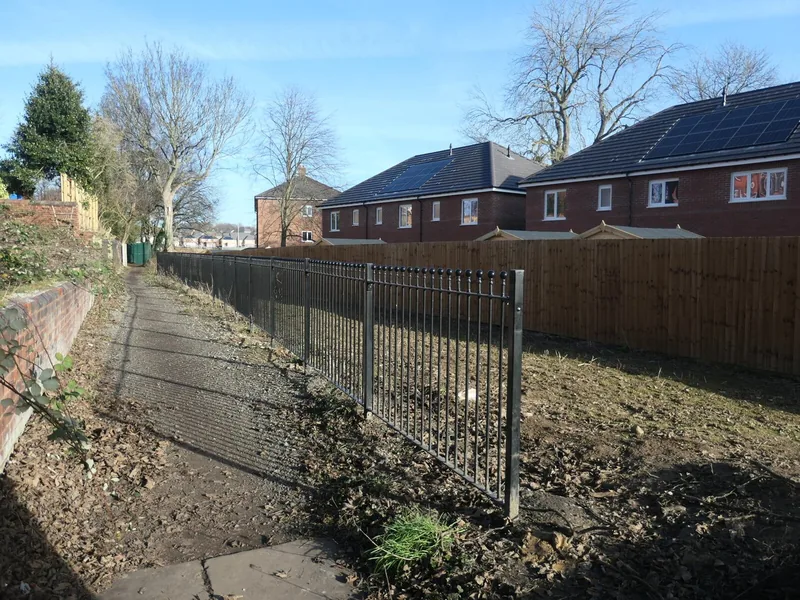
Ireland's actual boundary law (not the UK Party Wall Act)
Online articles often quote the UK Party Wall etc. Act 1996 or claim you automatically own the fence on your left. Neither applies in Ireland. Shared residential walls, garden fences, hedges and ditches in the Republic of Ireland are governed by Part 8, Chapter 3 (Sections 43 to 47) of the Land and Conveyancing Law Reform Act 2009.
Section 43: Party structure
- What it covers in plain English
- Includes any garden wall, fence, hedge or ditch sitting on, straddling or built so close to a boundary that maintenance needs access to the neighbour's side.
- Practical takeaway
- Most dividing fences between Irish semi-D and terraced houses qualify as party structures.
Section 44: Rights & duties
- What it covers in plain English
- Allows a building owner to carry out exempted repair or replacement works on a party structure, provided they make good any damage and cover reasonable inconvenience or professional advice.
- Practical takeaway
- Always agree access, dates and finish face with your neighbour before contractors arrive.
Section 45: Works Order
- What it covers in plain English
- If a neighbour refuses reasonable access or consent for essential boundary repairs, the District Court can issue a Works Order (initiated via Form 93A.2).
- Practical takeaway
- Court is a slow last resort; clear written communication resolves almost all garden replacements.
Sections 46 & 47: Terms
- What it covers in plain English
- The court can set working hours, reinstatement terms and conditions, or modify an order if circumstances change.
- Practical takeaway
- Agree contractor start dates and garden clean-up standards up front.
Price my fence
Four taps show your fitted price guide before we ask for a phone number. One local fencing contractor rings you, not five.
Concrete H-posts and timber panels, 15 m to 30 m, with old fence removal (€95 to €163/m): €1,700 to €4,550, supplied and fitted.
How the price is worked out
The range multiplies current Irish supply-and-fit rates per linear metre by the chosen run length, adding a per-metre allowance if an old fence has to be stripped and disposed of or if bays must be stepped along sloping, stony or root-bound ground. Standard residential prices assume 1.8 m height with concrete footings at least 600 mm deep. Matching pedestrian gates, tree-stump removal, rock breakers and narrow through-house carries are confirmed on a site look. Ask whether VAT is charged at 13.5% or 23%. Only a contractor who inspects the boundary line gives a firm written quote.
Four steps before replacing a shared Irish garden fence
- Check your deeds and Land Registry map first. Tailte Éireann (Land Registry) maps show general boundaries rather than millimetre-exact lines, while original developer deeds often state whether side boundaries are party structures.
- Talk to your neighbour before booking a contractor. Show the exact style and height (for example 1.8 m concrete H-posts with hit-and-miss panels so both gardens get the identical finished face).
- Put any 50/50 cost split in writing before digging starts. A short text or email confirming total budget, contractor quote and each household's share avoids awkward billing rows after completion.
- Photograph both sides of the boundary before strip-out. Recording existing flowerbeds, patios, sheds and cable runs along the fence line acts as a simple pre-works Schedule of Condition.
If a neighbour declines to contribute financially, you can still erect a replacement fence entirely on your own side of the boundary line inside Class 5 height caps without removing a structure that belongs solely to them. See Class 5 fence planning rules.
Related fencing guides
Class 5 fence planning rules2.0 m rear cap, 1.2 m front building line limit, estate covenants and €80 Section 5 checks.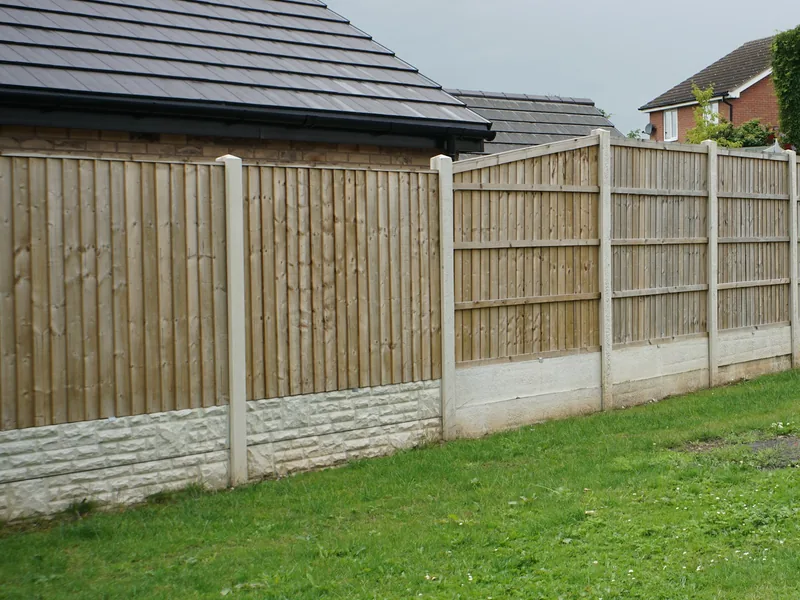 Concrete H-posts & timber panelsConcrete posts, 300 mm gravel boards and slotted timber panels built for damp Irish gardens.
 Old fence removal & sloping gardensBreaking out old concrete footings, working past tree roots and stepping panels on falls.
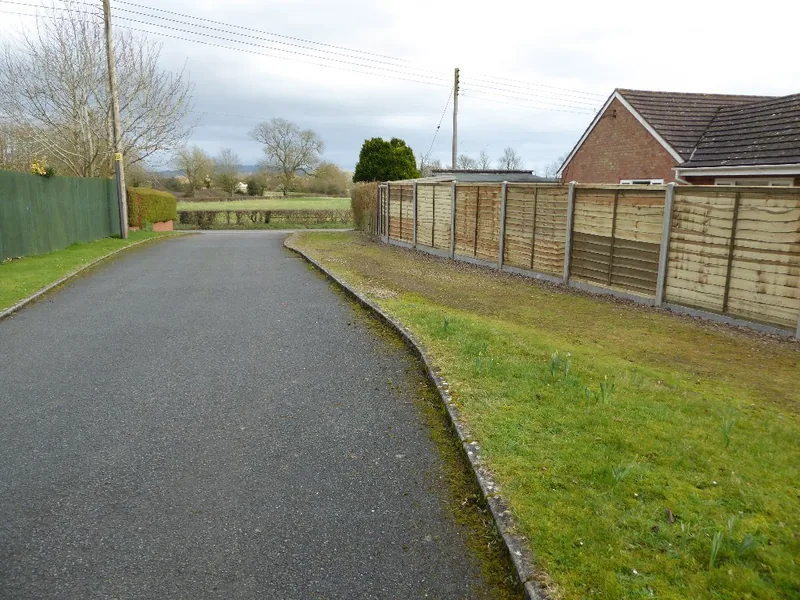 VAT rules & quote checklistRevenue's 13.5% vs 23% two-thirds rule and ten lines every written fencing quote should state.Fencing prices per metreSupply-and-fit Irish metre rates across all six fence systems, strip-out and slope extras.Dublin fencing contractorsSemi-D concrete H-post conversions, tight side-passage access and coastal wind specs.
Fencing questions answered plainly
Who owns which side of a garden fence in Ireland?
There is no automatic left-hand or right-hand ownership rule in Ireland. Most modern estate dividing fences are shared party structures unless house deeds specify sole ownership.
Does my neighbour have to pay half for a new garden fence?
No neighbour can be forced to pay half for an optional upgrade they did not agree to. Where a storm destroys a shared fence, most neighbours split a practical replacement 50/50 once shown a clear written quote.
Which way should the good side of a garden fence face?
Traditionally the rails sit on the builder's side, though there is no strict Irish law on this. Choosing concrete H-posts with double-sided panels or hit-and-miss boards gives both neighbours an identical finished side.
Can a contractor access my neighbour's garden without permission?
No. Contractors need your neighbour's consent before stepping onto their lawn. If access is refused on an urgent party-structure repair, Section 45 of the 2009 Act provides a District Court Works Order route.
Every Irish fencing guide on this site
Fence styles
Specs, costs & law
Check your boundary cost before booking a visit
Pick the fence style, rough metre run and whether an old boundary has to come out. One written quote comes back from a single fencing contractor in your county.